April 10, 2014

Psychedelic Posters: How they Exploded our Minds

Sixties Psychedelic Posters: How they exploded our minds

Now that we can acknowledge the contribution of the sixties at a safe distance from its turmoil, it is remarkable to see how its influence continues to spread. Posters played a key role  in this dissemination of libertarian ideas. Recently, there was an exhibition of the impact of Pop Art at the Fashion and Textile Museum. Tucked away upstairs was a row of psychedelic posters of the Beatles and Donovan and I realised how much the visual language of mind-bending substances has seeped into the general culture since the heyday of pill popping on fields of festival mud. 


Here are some random thoughts embedded in a short video to underscore how the sixties really did alter the way we see things. If these posters seems normal now it is because we have absorbed the visual tricks. The photos in the video are my own and contain reflective glass, which I retained as interesting and self mirroring in and of themselves, as the 'trompe l'oeil' effect puts the mind in not one but two minds. 

Bob Dylan Poster on Copper Plate
The root of “psychedelic” is two fold: 'psyche' meaning 'mind or soul', and 'delos' meaning 'manifesting.  So this is a 'mind manifesting' kind of experience, as triggered frequently by acid or mushroom trips, but which can also be accessed less directly through yoga and meditation techniques. It is both visceral and visual, stimulating the optic nerve and even triggering the activation of the pineal gland, the third eye. Anyone who closes their eyes, and sees visions will know this. But, it is more than just a lava-lamp style projection of gloopy shapes. Colours are rarely muddy or dull, but eye-poppingly iridescent, starkly contrastive, and sparking with the laser-light Shiva dance of energy molecules: Once this is experienced first hand, it is rarely forgotten. Even if you have not 'seen' it, you may receive a whiff of visual otherness from looking at the explosion of posters from the sixties.

The psychedelic poster distinguished itself from other posters by its dazzling visual effects. One aspect of these posters that stands out is that apparently solid boundaries became blurred suggesting the world we are accustomed to is not stable, but a portal to other dimensions that remain hidden to our everyday perception. 

Some of the best posters even used a copper plate for their effect like the one of 'Bob Dylan'. Its swirls have a metallic tint, echoing the use of iridescent colours elsewhere
 

George Harrison and the Third Eye
 An experimental development in the sixties was in the light show to accompany rock concerts. Joshua Light Show performed alongside Jefferson Airplane, Tim Buckley, and Spirit at the Fillmore East between 1968-71. These light shows were projected over the performers using colour wheels, aluminium foils, overlayed with original film footage forming a constantly changing montage of the real and unreal. It is difficult to encapsulate the 3D into the 2D print format, yet that is what the simple screen print sixties poster attempted. Screen printing offered the potential suggesting a bleed effect apparently melting the solid world, proving Einstein's E= MC squared theory that matter is vibrating energy. The other aspect is the fractal style, where each part, geometrically precise is repeated endlessly to form a larger whole.  


Blake's famous lines are very evocative at this point: 

"To see a world 
in a grain of sand 
and heaven in a wild flower. 
To hold infinity 
in the palm of your hand 
and eternity in an hour."

Wes Wilson  Poster
The person who had a great impact was Wes Wilson who was willing to experiment with distortions of the usually geometrically strict style of typographic design so you got a lot of squidgy-looking letter shapes, reminiscent of Art Nouveau, but taking it further to a full on optical illusion where the letters have an elasticity all of their own. 

As I looked longer, the images can become hypnotic, as they typify Optical illusions, which for a hypnotherapist is always intriguing as it automatically propels clients into an interior space. But this impact works on the viewer as an aesthetic experience too. Just how long does it take when gazing at an image to become lost in a trance? A few seconds? Each face locates you at the doorway to another world, yet it also reflects the self through the windows of the eyes. 

Stare at the eyes long enough and you're gone into that space.

The focus on faces is also typical of Pop Art, which was exerting massive influence with the screen print work of Andy Warhol. Such images of pop stars such as John Lennon, George Harrison and Jimi Hendrix are drawn from photographic images. These lend themselves easily to becoming iconic, as areas of the face do not have the subtlety and shading of realism, but need to reduce shapes to bold, simple forms, suggesting the subjects are god-like, and transcend the real.
Ken Wilson: Are You Experienced?
Psychedelic posters have added a real zest to design, pushing the boundaries outwards. According to Johnson, author of Are You Experienced? “The psychedelic movement helped people move beyond the act of viewing art into a deeper experience of it......Art is no longer something just to be admired. It’s something to consume and to feel.” (Wild Things).

Today there is fractal generating software which mimics the direct experience of psychotropic vision, allowing for multiplication of forms in computerised video art. This pushes way beyond the simple standalone poster. Images do not stand still but continually morph. Hence, video now appears to predominate with Rihanna  and Azealea Banks making use of such digital video art and psychotropic effects for their music videos under the guise of 'seapunk' - a style immersed in psychedelic visual - they are just one flourishing branch of the sixties explosion alive and proliferating happily.

It would be nice to see a fuller more substantial exhibition of these posters at some stage, recognising the significance of the Sixties-style poster. The link to acid trips may have been exaggerated but something exploded a window open in the minds of poster designers, which they may or may not have needed to create these images. Let's hope they do not sink into oblivion but are celebrated for also opening avenues in the minds of the public that continue to keep opening.

Kieron 


© Kieron Devlin, 2014
all rights reserved. 

www.kierondevlin.com 

https://www.youtube.com/user/KDjupiter


July 06, 2013

Doing the 30 Day Bikram Challenge


Doing the 30-Day Bikram Challenge

So today is day 30 !  I have completed my Bikram ‘challenge’-  90 minutes of yoga performed in 105 degrees (40 C) heat daily for 30 consecutive days. That’s almost 50 hours of yoga in one month. It does not sound much, but takes a lot of persistence and stamina to keep going when the body is in meltdown.  I had thought it would be easier, since I did it unofficially last year without much of hitch. This time I was plagued by back pain, but now the light at the end of the tunnel has dawned, I can take it easy.

jewelintheworld.wordpress.com

I did well for the first 15 days, not suffering any problem, feeling energised, doing all the poses, improving even on my Standing Head to Knee pose; but then I ran into a snarl, with lower back pain for the past ten days or so. I ignored it at first, thinking it would go away. But it turned nasty. I had to decide: should I stop and lose the momentum of the 30-day challenge, or carry on regardless till the end? In my case it is an old recurring sciatic pain, that is indescribably sharp, gnawing at the point where the sciatic nerve meets the pelvic bone, but also broadly across my entire nervous system. So it might have been sensible to just give up. Most would go running to their doctors and be talking about surgery before you know it. But I waited to see.

One of the rules is if you leave the room before the class ends, it does not count. I can see the sense in that, because it signals to the brain 'I want an easy time'. I can totally understand why people want to escape the room. It is hotter than hot. At times, you feel  you might just go whooooompf and spontaneously combust. If you eat too much you can also feel queasy.  The combination is not good.  But, if you head for the door early once, you are just more likely to give up too soon the next time. So escape was not an option. I chose to battle on through. But the damned heat - the heat!! Only for mad dogs and Bikramites.  It ramped the humidity levels right up this June. Heat tends to reach a peak about two thirds the way through the class, so once you get over that point, it's downhill.  A mere wisp of cooler air under the door from outside feels like bliss.  

You get these articles such as   Bikram is Too Hot To Handle  that love to rouse fears and worries around the safety of Bikram yoga, how it might encourage high blood pressure and dehydration. That may be true, but the body regulates its own temperature through sweating, so in fact it remains stable, and after the class, you feel you can trip the light fantastic, with the post-class high, so it all balances out. It is good to be forewarned about the dangers- and Bikram is certainly not for everyone - there are many  other worthwhile, nourishing forms of yoga, but this type of article typically dramatises in order to be ‘sensational’ without examining it from all angles, thus appealing primarily to fears and worries for anyone considering doing Bikram. If such articles proclaimed it was good for you, it wouldn’t make the front page. It would be seen as exaggerating or promoting. 


The heat is definitely a serious barrier to some. The phrase that came to mind in the meltdown was ‘this is doing my head in’ but  it leads to a reformation, creation feeds on destruction, so it feels like moulding and sculpting. It you can’t take it, you just have to get out. But if you do stay put, you realise heat is relative to cold. There is a vast range of sensations between the extremes. Tiny variations from hot to boiling, come sharply into focus against minute differences from cool to cooler once you exit the room. A cold shower after hot yoga is the perfect balm to feeling like a saucepan of overboiled milk.

Soldiering on through pain is a personal decision since one class, especially your first, is ‘like being hit by a truck carry rose petals’ according to  Benjamin Orr. Whatever you choose to do is right for you. For me, though, having that stickability has helped to increase mental rather than physical strength - bit of will power sharpening is going on- helping to show that you can endure in your life that you otherwise wouldn’t have thought. I love the phrase some teachers use: 'To fall out of a pose is human, but to get back in is yogi'.

Standing Head to Knee Pose

But I discovered that, even if I wanted to, I could not do forward bends, Padahstasana-and the Standing Separate Leg to Knee Pose as the pain shot through my lower back and hip making me feel about 70. That also made Standing Separate Leg pose, Toe stand, even Rabbit Pose, and the sit-ups after Savasana, near impossible.  I had either to pass, or pass out. It is unfortunately true that the ego wants to do every pose in order to prove itself fit enough - there's that competitive edge- but I learned to relax about that, watch the others in the room make all the effort, while I sat back, paced myself, breathed more slowly and deeply into the lumbar area.  It took control and truckloads of patience. I was still in the room. That is yoga enough in the intense heat.  

 Words completely fail to render the intensity of this kind of pain, made worse by the thought that I was completely over it. For it to pop up again now is depressing.  I turned to pain-killers and the odd glass of French brandy.  But this is a stopgap. It helps to respect the limitations and frailties of the body and to relish the amazing power of deep sleep and self-hypnosis to help heal. Mental resistance just increases the experience of pain. One teacher said ‘just being in the room is healing.’ That’s kind of right as, even if you don’t do a pose, you are doing it mentally, preparing for the time when you will do it -hopefully more elegantly with greater internal and external alignment. 

It is easy to think the pain was caused by doing so much Bikram yoga. But there are many factors to consider before  saying yoga caused the injury. I’ve also been cycling a lot further, and longer than usual. My bike park in the basement requires me to lift the bike wheels every day to lock on to the wall vertically, so I have to strain the lower back region. It could be my venerable age also, or lack of core muscle strength as one Pilates teacher in class observed.


Plusses

It’s a determination booster.

·      It increases your stickability factor, especially dealing with the heat. The brain thinks ‘If I can get through this, I can get through anything’.

·      Increases your endurance of the heat but also how long you can stay in a pose.

·      You start to eat better, naturally choosing lighter foods. 

·      You lose weight. My weight is mostly stable, but it has given me a trimmer waist  and I am 3 belt sizes smaller. People have noticed. 

·    It helps to control your body clock and sleeping patterns.

·      You certainly learn to appreciate any draft of cool air.

·      Helps break through the pain/pleasure barrier, sharpening your sense of how contrasts are there to offer a range of sensations, all are good.

·      Increases you awareness of pacing and ability to accept if your pose is not perfect.

·      It makes you feel energised, limber and flexible.

Minuses

·      It’s costly- you still have to pay your fees for this daily grind.

·      It is time consuming to do daily – you have to find the time or do a double, which acts for me as a deterrent. I don't want double trouble.

·      You can overdo it and stretch or compress beyond your limit, exacerbating any previous injury or pain.

·      You may not really see massive improvements in technique- in fact with me it felt like I was taking steps backwards.

·      Doing it in summer increases the humidity. You can be sweating after two minutes in the room instead of after ten. So dealing with the heat can be the main stumbling block.

* If you are in pain, only some teachers suggest modified poses, most just say skip them.


Doing the 30 day challenge, you are forced to pace yourself and that is a good thing- and probably the main thing I’ve learned. You can’t just hammer away at the body day in day out. `it goes in cycles of yin and yang, of peaks and troughs and the circadian rhythm. So being aware of when to push forward (yang) and when to just sit back and restore energy (yin) is vital to understanding how to get the optimum performance. By sitting out the forward bends, I felt much more prepared to do the backward bends. If you do all the poses, it gives your body no time to recover except if you doing the floor series. world if you. The Bikram sequence is full on, with only seconds between poses, so that pacing is essential if you are doing it daily. It's not the end of the world if you don't do some poses, though I agree this should not develop into a habit. As you as you can, get back into them.  
The Glad Its All Over Yogaholic Look at Sohot Yoga Studios
Will I continue Bikram? Yes, of course, as it has really given me a level of fitness I never hoped to have at my age, even though I am exhausted. But do I need a break? For yogaholics, a Bikram holiday is just missing one day of class, but I need a few days off. You need not be hell bent on transformation, in order to reach transcendence, it happens of its own accord, when you are naturally in alignment with a daily practice that requires discipline, commitment and focuses the bodymind to its sequence of tasks.  Bikram is perfect for that- for mindfulness, for meditation in motion.

It's all there already in those moments,  if you can notice.

Namaste.

Kieron

© Kieron Devlin, 2013
all rights reserved. 

May 19, 2013

Bikramarama!

The Bikram Series: Some articles about Choudry's version of yoga
Bikram Choudry at work

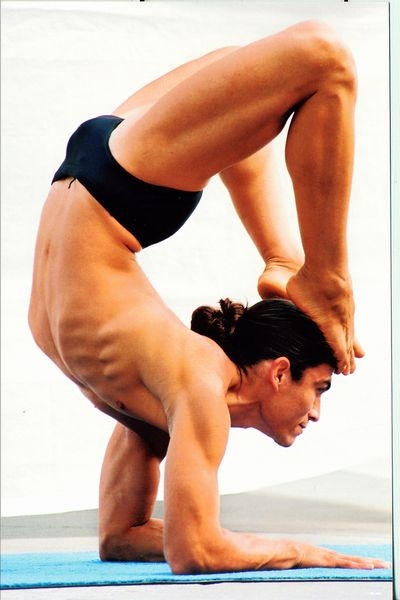
A while back I decided to write about Bikram yoga. I felt there was something important to say about how yoga triggers improvements in life, heals physical and emotional wounds, and highlights the indivisible mindbody connection. Having a fit body is a mere by product that just happens to be desirable. So I started pestering Bikram teachers with various questions. They have mostly indulged me benignly with their answers, but it led into into discussions about the impact of this type of yoga and about Mr Choudry himself, his pimp-like posturings, and even the value of the yoga asana championships, so called 'competitive' yoga, which for some is an oxymoron. I attended the UK yoga championships for the first time this year and found it thrilling, even at times unyogic. Yet, it all contributes to the massive interest in yoga in recent years which shows no signs of fizzling out. Take a look at this video I made of one of the teachers who entered, Alessandro Mauro, and it's a lesson in the perfection of form. Coached by Ky Ha, ex US champion, he really showed how it should be done.

The Indispensible Book on the Bikram Phenomenon
When yoga first became popular, there was a lot of poo-poohing of the practice that was negatively motivated by Christians fearful that the younger generation was being subtly brain-washed by Hindus. They feared that Hinduism was poised to take over the Western hemisphere. Now that there is a science to back up the benefits of yoga, the religious prejudices have fallen by the wayside. Yoga from a western perspective, in its various forms, has gone from quaint Eastern weirdness to 'hey there's something more to this', to full-on mainstream, everywhere-you-look, in the space of a few decades. This is all fine. The more interest is sparked in the poses, the more it leads to curiosity about how they are performed and practised, which leads to a search for the spiritual aspect. The foundation and origins of yoga, are less deeply embedded in ancient Vedantic philosophy than is commonly supposed. Nevertheless, yoga is where the mind body interface is most obviously situated. Yoga is something people can experience for themselves, not just know from books. So even competitions while seeming to be a paradox of the yogic spirit, still lead people to be curious about the hows and the whys, thus leading to some kind of enlightenment.

As I began thinking and becoming more curious, various different aspects of the yoga universe cropped up for attention: the mystery of the asanas, their names, and purpose, the neatness of the sequence, plus the language used to instruct in Bikramese Choudhuryesque, and its odd abruptness, and then the insight that how being in a yoga class was similar to being in a hypnotic trance, and could have the same mental reprogramming, life-changing impact. I wanted to learn more, read more, ask more.  One of the best current books around on Bikram, apart from the asana manuals, as it is one person's experience with it, is  Benjamin Lorr's Hell Bent: Obsession, Pain and the search for something like Transcendence in Competitive Yoga (2012) and apart from Lorr's readable, page-turning style, it highlighted some of the paradoxes of a yoga cult and how no one can really agree on its value, yet all agree that Bikram is a phenomenon to be reckoned with. There were still a lot of questions, and puzzles and misconceptions, all of which needed clearing up.

With yoga, it is personal. You either want to do it and stay the course, and effect a transformation, or you just dabble in the shallow end and can't ever make out what the fuss is about out in the deeper ocean. But with Bikram, you learn patience, and tenacity, more than stamina.  This is why it appeals to athletes. You learn endurance as well, as perfecting one single pose can take years of minor self adjustments and corrections. Some teachers say 'if you can't do it yet, don't worry, it took me five years,' laughingly reducing your months of  hard-sweated effort at standing head to knee pose to nothing. But it also is a reminder that it is the process and not the end point that contains all the joys, thereby suggesting it is not really competitive. Some can go deep into side bend as their spines are naturally bendable, but they lose all sense of form. So, struggling at your edge, which may be way behind anyone else in the room, is where the real work happens, and you can be a beginner for up to ten years before you might graduate to the Advanced Bikram class.

Because there is so much to say, and this is a mere introduction, I'm going to divide up the material into sections, and who is to say where it may wind up. Some of it here, some of it elsewhere in Yoga Journals, hopefully:

1) Personal experience and general ideas of Bikram: the day to day developments of doing 90 minutes in the heat and how it transforms the bodymind, including the asanas, the debate about the heat,  its value and the influence of the leader

2) The Language used in the dialogue; this will include the metaphors used.

Esak Garcia
3) The link between Bikram (or other yoga styles) and Hypnosis, how it is similar to a trance state where reprogramming the mind is happening. This potentially is the most interesting research area to explore, and I'm in discussions, still observing and researching, so I'm not in any hurry to arrive at any conclusions, but it's quite exciting to examine these often hidden and undocumented aspects of the yoga class.

So I hope that this will all be interesting, not just for those who are curious about Bikram and thinking about trying a first class ( go for it)  but for regular Bikram practitioners too who would like to reflect on what it is they are doing.

It's important to note that I'm not saying that Bikram is the only yoga style that can have these transformational effects, but it is the one that has worked best for me.
Jospeh Encinia doing the bridge

I haven't got the ultimate bendy back yet like Esak Garcia or Joseph Encinia and I'm nowhere near as good as the teachers, dare I say 'yet'? but I'm on my way.

Watch this space. 

Namaste.


© Kieron Devlin, 2013
all rights reserved. 

www.kierondevlin.com

https://www.youtube.com/user/KDjupiter

April 10, 2013

In My Bed


-->
 
Etienne Benassi

In My Bed

There’s a body in my
arms, sweet cameo of
profiles, links up contours
in this domain of warmth.

There are armfuls of torsos
Fell-swooning across the
sidelong limb, svelte scandal
at my fingertips.

There are erections that
bite like kissograms
(without the extra charge),

States of mind which burn
till my edges frazzle
and an envelope of new skin
folds smoothly around the flames.

You have to steam us
apart, like coming reluctantly
unstuck from sleep.


©

Kieron Devlin, 

April 01, 2013

CREATIVITY

Creativity
We all may wish to be more creative, but is it the preserve of the few, or do all of us have inner gifts? The fact is that most of us are under using our potential, and we can sense how creativity can add more quality and satisfaction to our life. But if we are all creative beings then why does it not always show up where we need it the most? Writers talk of being blocked. But who is blocking who? Why do we get stuck, give up, or worse, are even afraid to begin? It is as though we are standing in our own light, unable to see the shadow we create.

Feeling Blocked
Writer's block is not just limited to writers; it can strike anyone confronting a blank page with a task in hand. 'Page fright' can paralyze the nerves until the mind shuts down. Some say this might be the interference of two types of brain function, the critic or the left brain. Page fright is much more common than we imagine. Dorothea Brande, one of the great writing teachers believed that page fright that is never addressed on creative writing courses, yet it was often the main problem.

If you have something to say and cannot even get started on it, consider that you may be standing in the way of your own artistic potential. Sometimes we need help to find ways to clear our path and find renewed energy to complete the work. Whether you are already a practising artist or feel it is a path you have not yet fully developed, hypnosis can help you to realign with your true self, find the key to your own voice, be reminded of your calling, regenerate and nurture your artistic self.

Block does not just come in one variety, there are three main types:
  1. Creativity dries up temporarily:
    Just stop and take a breather, a drink, a walk, a chat. Usually this is not serious.

  2. Life gets in the way:
    relationships, duties, work, responsibilities take over or sidetrack you so you abandon your project. Life is trying to teach you something here. Ask what can I learn from this? Use it as source material for writing.

  3. You are really stuck:
    You stop completely, or avoid your project for weeks, months, even years. When you write a story, or express yourself freely, you need to expose things that are personal, so whatever this problem is, and it's usually not to do with writing at all, but something else, it has to be dealt with before you can proceed.
The tendency to perfectionism can also get in the way. Make space for mistakes and experimentation. Allow mistakes to be a source of learning, and your relationship with your work may become more relaxed.

Keeping Diaries and Journals
Many great writers and artists have kept journals and diaries. Writing is cathartic. It's a legitimate to talk freely to yourself without being considered stark raving bonkers. We need these dialogues with ourselves. The subconscious mind speaks a different language than the conscious mind, hence the importance of self talk, and improving the quality of self talk. In my experience, writing in your journal as personally and honestly as possible, can not just release blocks but can be a life saver.

I have found no other, easier method of self therapy than this. Here's where it gets really interesting though - in the eighties, psychologists and immunologists such as Glaser, Rubin and James Pennebaker in particular discovered that the physical act of writing, especially about difficult emotions, promotes a strong immune system. Not only does writing oblige the right and left hemispheres of the brain to cooperate - something worth doing - it also helps lower cholesterol, hypertension, stress, and promotes the release of endorphins. The point is that inhibition of thoughts can cause ill health.

A few rules to remember though: don't show your diary to anyone. Its value is in its privacy and regular uninhibited daily entries. Respect these rules and it becomes the ideal friend as it does not talk back or reveal your troubles to others. Keep it private and keep it regularly and over time, it opens a space in the mind that assists in pattern noticing, healing and integrating different aspects of yourself.

The Artists Way
The Artist's Way by Julia CameronThis very popular method was pioneered by Julia Cameron, author of The Artist's Way. She emphasizes reconnecting with your source using 'Morning Pages'. This involves slowing down and getting in touch with your unique self by writing freely every morning before you do anything else in the day. Her method has brought satisfaction to countless thousands of people. Just start you day by just writing all the things that concern you the most. Gradually, this process restores your ability to reconnect with the true you.


The Structure of Creating
Albert EinsteinNLP Master, Robert Dilts, believed there is a structure, a method, or habit of mind that can be learned by anyone to ensure creative flow. He studied the exact sequence of actions that great creators such as Leonardo Da Vinci, Albert Einstein, and Walt Disney followed in their creative process. Often these creators did not know how they achieved what they did. Yet they followed a specific sequence which can be followed by anyone. Walt Disney, for example, had a system of changing viewpoints during his creations to make them the absolute best they could be. He would start from the Dreamer position, move to the Realist, then become the Critic - in that order. This helped to achieved multiple viewpoints and a greater roundedness to his work. Anyone can adopt this technique.

Once this sequence has been absorbed it can reignite the energy you need to fuel your own creative work. Remember, BEGIN is an anagram of BEING.

Finding Your Zone
Creativity is not just for writing the next great novel or painting, it can be a simple as writing a letter, decorating a room, finding an unusual solution to a common problem, or cooking dinner in a unique way no one has thought of or attempted before. We all do this yet don't feel we are particularly 'creative'.

This process is activated each time you begin to write freely. Just getting in touch with who we are again. Keeping a daily journal can have the effect of uncovering who we really are, and if we are in tune with our own metaphors and images, it can add another dimension to our lives. We just need to find that rhythm, find that flow which athletes call 'the zone'. This is your peak performance state and you act your best and even outperform yourself while in this state of inspiration.

Please contact Kieron for more information. 

--> © Kieron Devlin, 2010, all rights reserved.
References:

Cameron, J. (1994). The Artists Way. London: Pan
 

Dilts, R. & Epstein T. (1991). Tools for Dreamers: Strategies for Creativity and the Structure of Innovation. California: Meta Productions.
 

Pennebaker, J.W. (1990). Opening up: The healing Power of Expressing Emotions New York: Guilford Press.


www.kierondevlin.com 

https://www.youtube.com/user/KDjupiter

March 29, 2013

More Poetry from the Vaults


Recently, I rediscovered a bunch of poems that had been shuttered away in the back bedroom cupboard of my mother's, squashed at the bottom of a box I hadn't opened for twenty years.  Aouli Day was inspired by a trip to Morocco in the 1980s and my first taste of culture clash.


Aouli Day in Larache

Just as at the Lixus,
half-baked
tumble-down Acropolis,
silence, and a lone cypress tree
with curvature of the spine.

The smell reaches us
by camel-express,
all banks are closed, all shops,
all restaurants. ‘Tomorrow’ they say,
‘Tomorrow, you’ll see’
in the souk
inquisitive sheep peer
out of crates,
waiting, as if for a train
that never runs on time.

Dawn’s signal cock-a-doodle choked,
the augury of its fate,
a premature strangulation.
The early morning Koran is recited
On the radio.
‘How is yours today?’ she asks,
‘you know. On the hole?’
we cannot digest anymore.
In place of sleep,
we drowse.

Eager boys watch skewered lambs
hiss on hot black coals
intensify the noonday sun.
Whole families drink, wash faces,
Clothes, rinse entrails
at the street tap,
Immunised by fasting.
Children stare at flies,
and we aliens, the English.

‘inevitably’ we say’ the point is
that there is none’.
All journeys- this one too-
Go through stark blue and
white-washed shanty town cabins,
the way to Hassan’s ‘casa blanca’.
Have sensational attributes
Why, for instance,
are we made to feel like
cash registers on legs?

High-jacked out of the time-space
Continuum,
We are unreal cut outs,
people without a point,
wilting under the strain,
like a new leisured class,
Who rendevous at the frontier,
where water, sky and desert
Intersect,
at night, retreat to elementals,
primary spirits.
 
Abdul Rashid sharpens
the kitchen knife.
The head came off in one strong,
stroke; the roof terrace
is covered in blood.
‘He is a tailor’ says Hassan.
But he might be better
employed in an abbatoir.
Perhaps –we think-
he is gentle to his wife
and five children;
there’s another one on the way.

I know how it felt,
the food and me did not mix well.
Sheep’s lung, heart, bladder,
sheeps’ head in cous-cous.
Ventricles stick in the throat
like rubber tubes.
They beg us to ‘eat more’.
We pray not to vomit, or seem
ungrateful at the simple
hospitality.

It stands to reason,
this fulminating slaughterhouse;
this multitude of village prayers,
burnt offerings, dances,
Allah’s unearned income,
sets the imagination
ceremonially askew.
The music tells me this;
its repetition.
The essence of the bloody
thing is a magnificent trance.

Holiday tummy is irrelevant.
We might as well be
imaginary and not particular
beings, for our fly-on-the-wall
Usefulness is in passing through,
waving travellers cheques
like magic wands,
abhorring the presence of
so much coca-cola, but
The children find us funny.

Why did we come?
To find new interests,
A more than we bargained for
two-week package to an Agadir hotel.
Hassan would give anything
to marry an English girl,
But the uplift out of
pointlessness,
humbles us and
makes us lean.


©  Kieron Devlin, 1987

Larache 1986